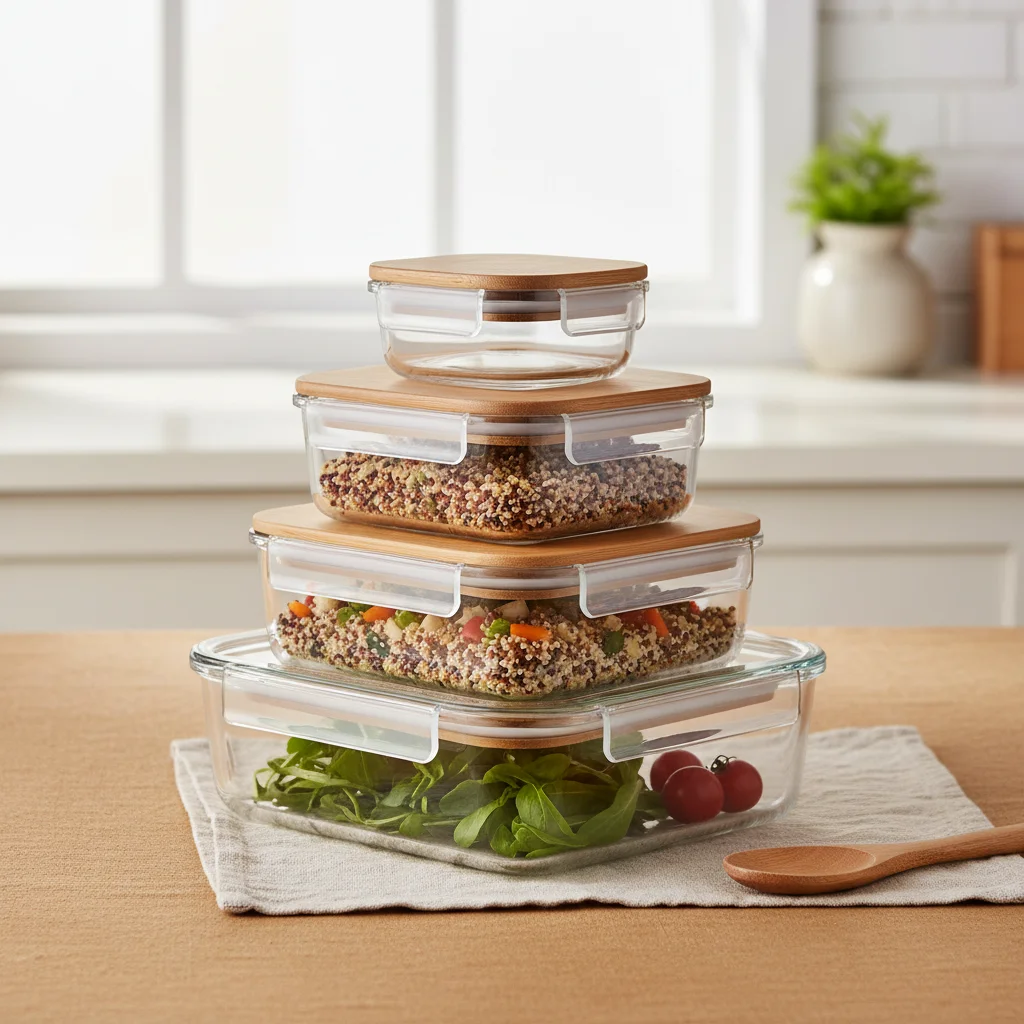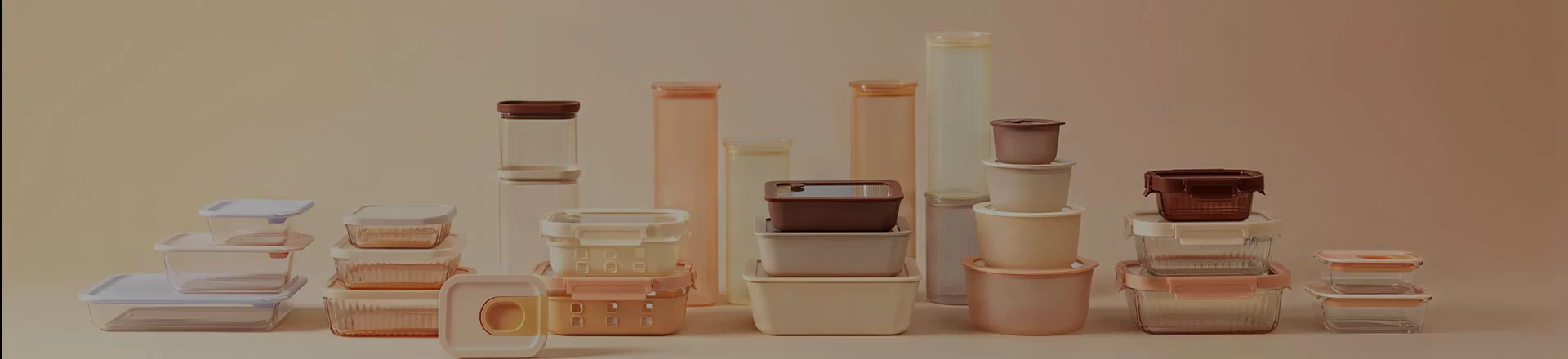
The global food storage market is witnessing a significant shift toward high-performance materials that can handle the rigors of modern meal prep and rapid reheating. For B2B buyers and brand owners, sourcing ODM microwavable glass storage containers has become a priority as consumers move away from plastics in favor of non-toxic, thermally stable alternatives.
The technical challenge lies in balancing structural durability with thermal shock resistance. To be truly "microwavable" and "oven-safe," a container must withstand extreme temperature fluctuations without compromising its molecular integrity, a requirement that necessitates the use of specialized borosilicate glass over standard soda-lime glass.
This analysis examines the engineering requirements of professional-grade glass containers, comparing material performance and exploring how ODM partnerships allow brands to implement specific functional upgrades, such as airtight locking mechanisms and aesthetic ribbed designs, to capture market leadership in the kitchenware sector.


The core of any high-quality microwavable container is the glass composition. High borosilicate glass replaces a portion of the sodium oxide with boron trioxide, which significantly lowers the coefficient of thermal expansion. This molecular shift prevents the glass from expanding or contracting rapidly when exposed to heat, which is the primary cause of shattering in standard glassware.
For ODM projects, utilizing borosilicate glass ensures that the product meets strict international safety standards, such as FDA and LFGB. This material is inherently non-porous, meaning it does not absorb food odors or stains, providing a hygienic baseline that is essential for professional food storage and preparation.
Thermal resilience is measured by the temperature range a container can withstand without failure. Professional-grade borosilicate containers are engineered to operate across a massive spectrum, often from -40℃ for deep-freeze storage up to 560℃ for high-heat oven applications. This versatility allows a single vessel to move from the refrigerator to the microwave or oven seamlessly.
However, "microwavable" does not mean "invincible." The primary engineering risk is not the temperature itself, but the rate of temperature change (thermal shock). High-quality ODM glass is processed to maximize its shock resistance, ensuring that moving a container from a freezer to a microwave does not result in stress fractures.
Beyond the glass, the lid material is critical. Polypropylene (PP) lids are used because they maintain stability at elevated temperatures and provide the necessary flexibility for a secure seal. In a professional ODM workflow, the lid's heat deflection temperature is carefully matched to the glass's thermal output to prevent warping.
A storage container's value is defined by its ability to preserve freshness. This is achieved through a multi-component sealing system consisting of a rigid PP lid, a flexible silicone gasket, and a mechanical locking mechanism.
From a design perspective, the addition of ribbed textures or color-striped glass is not merely aesthetic. Ribbed surfaces can provide better grip for the user and add a layer of structural reinforcement to the glass walls, while the transparency of the glass ensures instant content identification.
When evaluating storage solutions, buyers often compare borosilicate glass against stainless steel and plastic. While plastic is lightweight, it fails in heat resistance and chemical stability. Stainless steel is durable and shatterproof but lacks transparency and cannot be used in microwaves.
Borosilicate glass offers the optimal middle ground: it provides the transparency of plastic and the thermal resilience of industrial materials. This makes it the superior choice for applications requiring both visibility and heat processing.
For global distributors, the Original Design Manufacturing (ODM) model is essential for differentiation. Rather than selling generic containers, brands can customize the aesthetic—such as the ribbed glass patterns—and the functional capacity of the set to match specific regional consumer preferences.
Strategic ODM partnerships allow for the integration of specific certifications (BSCI, ISO, FDA, LFGB) and customized packaging, ensuring that the product enters the market as a premium offering. This approach reduces the time-to-market for brands while leveraging the manufacturer's established quality control and supply chain efficiency.
The food storage industry is moving toward "Zero-Waste" ecosystems. Glass is inherently more sustainable than plastic because it is 100% recyclable and has a significantly longer lifecycle. The evolution of borosilicate manufacturing has reduced energy consumption during the melting process, further lowering the carbon footprint of these products.
Future trends suggest an increase in "Smart Storage," where containers are designed to fit perfectly into modular refrigerator systems to reduce food waste. We are also seeing a rise in demand for aesthetically driven functional ware—products that are beautiful enough to serve as dinnerware but durable enough for long-term storage.
The shift toward eco-conscious consumption means that the presence of certifications like DGCCRF and LFGB is no longer optional; they are fundamental requirements for B2B buyers who must guarantee safety and sustainability to their end consumers.
When sourcing glass containers in bulk, procurement managers should look beyond the price per unit. The true cost of ownership involves the failure rate (breakage during shipping) and the longevity of the sealing components.
A robust evaluation framework focuses on three pillars: Material purity (absence of contaminants), Seal integrity (leak-proof testing), and Thermal stability (shock resistance).
The following matrix provides a baseline for comparing different configurations of glass storage systems based on professional application profiles.
| Configuration Type | Thermal Range | Sealing Level | Recommended Use Case |
|---|---|---|---|
| Standard Soda-Lime | Moderate | Basic | Dry Food Storage |
| Basic Borosilicate | High | Airtight | Home Meal Prep |
| Professional Ribbed | Extreme | Leak-Proof | Commercial Kitchens |
| Industrial Grade | Extreme | Vacuum-Seal | Laboratory / Pharma |
| Light-Duty ODM | Moderate | Basic | Promotional Gifting |
| High-Duty ODM | Extreme | Leak-Proof | Premium Retail Brands |
Borosilicate glass has a much lower coefficient of thermal expansion than soda-lime glass. This means it does not expand or contract as aggressively when exposed to rapid temperature changes, which significantly reduces the risk of thermal shock and shattering during the microwaving process.
While the borosilicate glass body is highly heat-resistant, PP (polypropylene) lids are designed for sealing and protection. For best results and safety, it is generally recommended to loosen the lid or remove it entirely during microwaving to allow steam to escape and prevent the lid from warping due to internal pressure.
The 4-locking mechanism applies uniform vertical pressure across the perimeter of the container. This force compresses a food-grade silicone gasket between the lid and the glass rim, creating a physical barrier that prevents air and liquids from entering or exiting the vessel.
The high borosilicate glass used in these professional containers is engineered to withstand temperatures up to 560℃. However, this applies only to the glass body; the lids must be removed before placing the container in a conventional oven.
Yes, through ODM services, brands can customize the glass design (such as ribbed or smooth), add custom logos, and specify particular capacity sets. Minimum order quantities (MOQ) typically apply, such as 3,000 pieces, to ensure production efficiency.
For global market entry, ensure the manufacturer holds FDA (USA), LFGB (Europe), and ISO certifications. For social and ethical compliance, BSCI certification is a critical indicator of a responsible supply chain and fair manufacturing practices.
The transition toward ODM microwavable glass storage containers is driven by a convergence of consumer health awareness and technical advancements in borosilicate glass processing. By combining extreme thermal resistance (-40℃ to 560℃) with precision-engineered airtight sealing, these products solve the primary pain points of traditional food storage: contamination, leakage, and thermal failure.
For B2B partners, the key to success lies in selecting an ODM partner who can blend these technical specifications with market-driven design. Investing in high-performance, certified glassware not only ensures end-user safety but also builds long-term brand equity through durability and sustainability.

If you are interested in our products, you can choose to leave your information here, and we will be in touch with you shortly.